
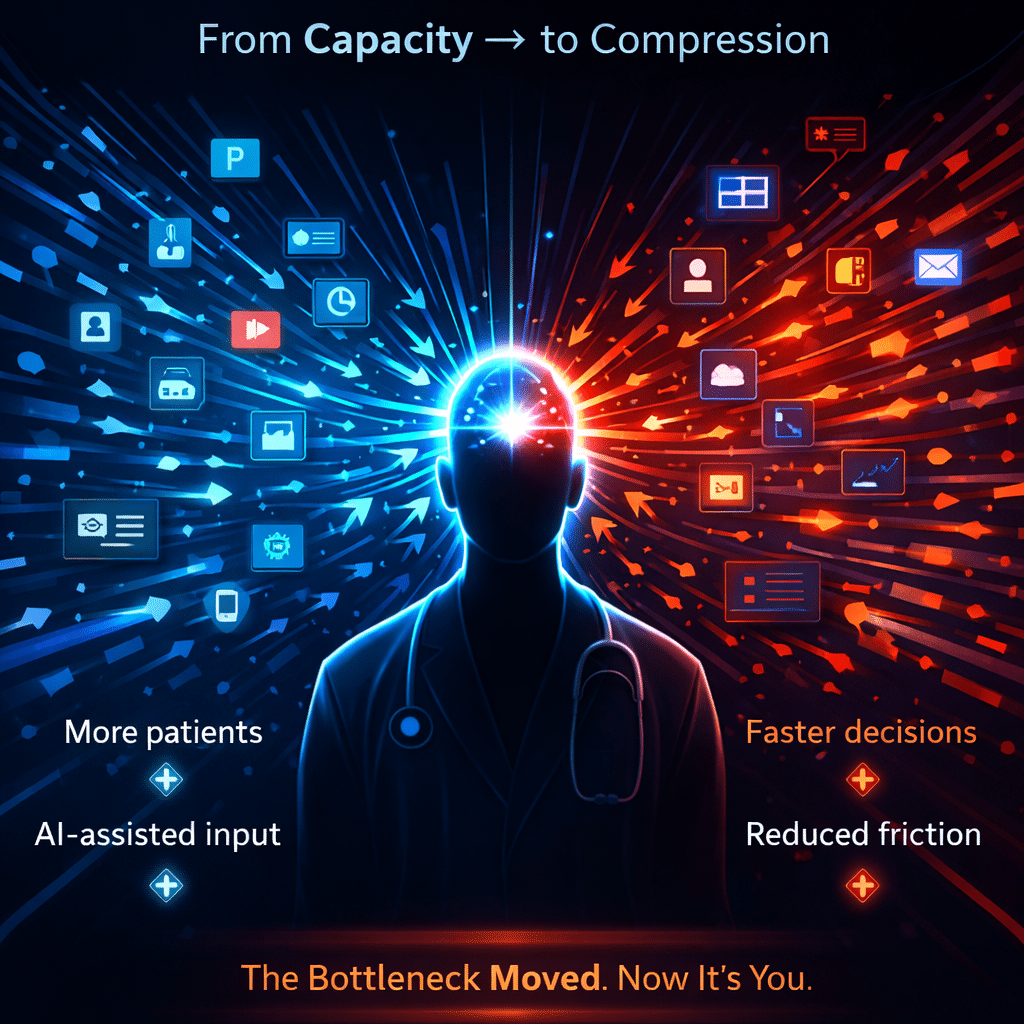
From Capacity Expansion to Cognitive Compression in Clinical Practice
The current conversation around AI in healthcare has largely focused on documentation.
AI scribes reduce charting time, improve workflow efficiency, and allow clinicians to spend more time with patients. These are meaningful improvements.
But they also introduce a less obvious dynamic: capacity.
When documentation friction is reduced, clinical capacity increases. More can be done in the same amount of time.
What happens next is not determined by the technology—it is determined by the structure in which that technology is deployed.
In many systems, increased capacity is not returned to the clinician. It is absorbed. Schedules expand. Throughput increases. Expectations shift.
This is the first-order effect.
The second-order effect is now beginning to emerge.
As AI begins assisting not only documentation, but clinical decision-making, individual decisions may become easier. Pattern recognition improves. Information is surfaced more efficiently. Routine cognitive tasks are offloaded.
But again, the system does not slow down.
It accelerates.
More patients are seen. More decisions are made. Less time exists between them.
The bottleneck does not disappear.
It moves.
From documentation to the clinician.
More specifically, to cognition itself.
This is not an argument against AI. In many ways, AI meaningfully improves the clinical workflow.
But it does change where limits emerge.
Cognitive effort per decision may decrease.
But total decisions per unit time increase.
The result is a form of cognitive compression—where more decisions must be processed in less time, even if each individual decision is easier.
This distinction matters.
Because it suggests that improvements in efficiency do not automatically translate into reductions in cognitive demand. Instead, they often shift where that demand is experienced.
The question, then, is not simply whether AI helps.
It is where the pressure goes next.